


 +91-85588-96644


Call Support +91-85588-96644


| Choose Exam Category |

How a one-hour test forced a global industry to reinvent itself
In global admissions, English testing used to be predictable. Fixed centres. Fixed dates. Multi-hour formats. Long result cycles. Institutions built processes around that reality. Then the Duolingo English Test entered the scene and quietly questioned almost every assumption. This is not a story about an online test. It is a story about how one product forced an entire category to rethink speed, security, cost, and credibility at the same time.
A Different Starting Point
Traditional English proficiency exams were built as logistics operations. They relied on physical test centres, seat availability, and manual layers of administration. The Duolingo English Test was built as a digital platform from the beginning. According to official DET documentation, candidates can take the test online, on demand, and typically receive results within about two days. It uses computer adaptive testing, meaning question difficulty adjusts based on performance, allowing the exam to estimate proficiency in under an hour. That design choice matters. Adaptive testing increases measurement efficiency. Instead of asking many fixed-difficulty questions, it asks fewer but more informative ones. This shift compressed test time without simply "making the exam shorter". It changed the productivity of assessment.
Security at Scale
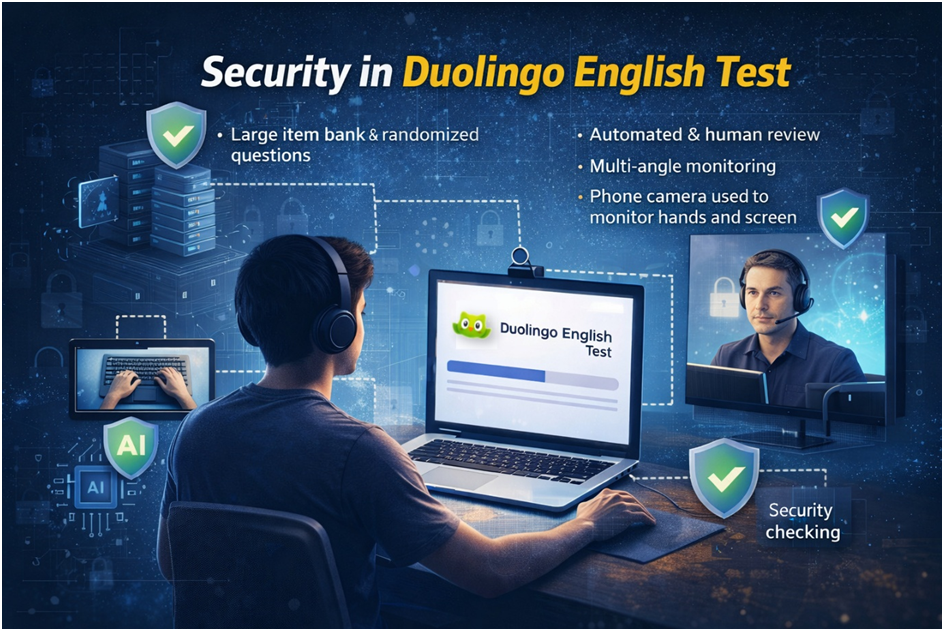
Remote testing is only viable if institutions trust it. DET built its model around a large item bank, partial randomness in question delivery, and a combination of automated systems and human review for integrity checks. Its published white papers outline how scoring and administration processes are structured to reduce predictability and limit item harvesting. The test also requires multi-angle monitoring, including the use of a secondary camera via mobile phone during the session, as described in Duolingo's official handbook. The key insight is this: DET did not treat online delivery as a convenience layer. It treated security architecture as a core product feature.
Adoption followed quickly. Duolingo publicly reports that the test is accepted by more than 6,000 institutions worldwide. That scale matters because admissions ecosystems operate on network effects. Once enough universities accept a test, counsellors recommend it more confidently. Once enough students take it, institutions grow more familiar with its score interpretation. Faster turnaround times also align with rolling admissions and late-cycle decisions. A two-day reporting window fits modern admissions timelines far better than legacy processing cycles. Operational compatibility often drives adoption more than marketing.
The Competitive Response
DET did not expand in isolation. Its growth coincided with visible changes across major providers, and those changes accelerated in 2025–26.
TOEFL: Reinforce at home, then go adaptive
ETS announced a staged transformation of TOEFL iBT. From May 30, 2025, the TOEFL iBT Home Edition introduced updates aimed at improving consistency and security, including ETS-trained in-house proctors and AI-assisted identity verification. More significantly, ETS confirmed that from January 2026, TOEFL iBT Reading and Listening sections will adopt a multistage adaptive design, allowing the test to adjust difficulty based on performance. This is not a cosmetic redesign. It signals alignment with the efficiency expectations that adaptive models popularised.
IELTS: Controlled digital expansion
IELTS has continued digital expansion but anchored it in credibility signals. IELTS Online explicitly states that it uses both human and AI proctoring, and speaking is conducted via live video call with a certified IELTS examiner. At the same time, IELTS has emphasised operational convenience within its established structure. Computer-delivered IELTS now advertises results in as little as one day in many locations, and One Skill Retake has been expanded as a flexibility mechanism. However, IELTS Online is not accepted for immigration purposes, signalling that use-case segmentation is becoming sharper.
PTE: Format refinement and online tightening
Pearson announced enhancements to PTE Academic beginning August 2025, including new speaking tasks such as "Respond to a Situation" and "Summarize a Group Discussion," aimed at greater real-world authenticity. On remote delivery, Pearson publicly confirmed that PTE Academic Online, introduced during the COVID period, is no longer in use. After detecting organised malpractice in 2023, Pearson suspended the service, investigated, and revoked affected scores to protect integrity. The pattern is clear. Remote delivery remains viable, but only under defensible control frameworks.
The Debate Over Construct and Credibility
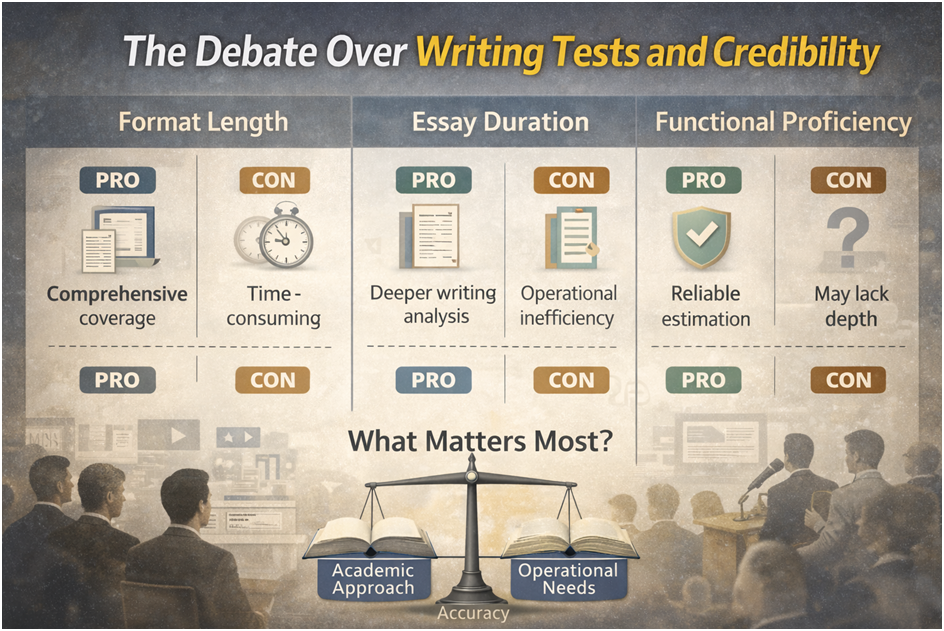
Growth has not been without scrutiny. Academic discussions have examined predictive validity and the scope of writing tasks across English assessments, including DET. Media reporting has highlighted debates about what constitutes sufficient evidence of academic readiness, particularly in extended writing contexts. This tension is expected in any evolving assessment system. The important point is that DET's rise has triggered substantive discussion about what universities truly need from a language test.
Is it format length?
Is it essay duration?
Or is it a reliable estimation of functional proficiency within operational constraints?
The debate itself signals transformation.
Recent developments show that remote delivery remains sensitive to integrity risk. Pearson's public confirmation that PTE Academic Online was discontinued following malpractice detection demonstrates how quickly trust variables can shift. At the same time, ETS is reinforcing the TOEFL Home Edition model with redesigned support structures and identity verification systems. IELTS Online continues operating with combined AI and human proctoring but remains segmented by use case. The lesson is not that at-home testing is unworkable. The lesson is that credibility must be continuously earned and demonstrably protected.
DET's entry altered five structural assumptions.
1. Speed became a competitive necessity.
Two-day reporting is now a benchmark expectation.
2. Adaptive testing moved to the centre.
Measurement efficiency is no longer optional. By 2026, even TOEFL is shifting toward multistage adaptive design.
3. Digital-first is credible for admissions.
The pandemic accelerated this, but DET institutionalised it.
4. Cost sensitivity became visible.
Lower entry barriers expanded access for students globally.
5. Security architecture became a product differentiator.
Not just a compliance requirement, but a competitive variable.
These shifts influence how coaching institutes design preparation, how universities structure policy, and how regulators approach oversight.
Assessment adoption does not scale on acceptance alone. It scales on preparedness. DET strengthened its ecosystem by collaborating with preparation platforms such as TCY, ensuring structured practice environments and aligned preparation tools were available to students and counsellors. This addressed a key adoption barrier. Counsellors are more likely to recommend a test when credible preparation support exists. Structured prep availability reduces perceived risk. The strategy was not just about direct-to-student demand. It was about embedding within advisory networks and preparation infrastructure. Ecosystem thinking accelerated institutional normalisation.
Three forces are likely to shape the next phase.
First, regulatory scrutiny will intensify.
Providers will invest further in AI-supported monitoring, anomaly detection, and identity verification systems.
Second, hybrid models will dominate.
Admissions use cases may continue embracing secure remote formats, while immigration-linked frameworks may favour controlled centres.
Third, competition will drive further optimisation.
Shorter formats, adaptive design, faster reporting, and clearer subscores are now embedded expectations across providers.
DET did not eliminate traditional tests. It forced them to adapt. The real transformation is not about one exam replacing another. It is about redefining what modern language assessment must deliver: speed, flexibility, defensible security, preparation infrastructure, and operational fit. The ecosystem has shifted permanently toward digital credibility and measurable efficiency. And that may be the most enduring change of all.


