


 +91-85588-96644


Call Support +91-85588-96644


| Choose Exam Category |

CUET-UG arrived with all the ingredients that normally mint a coaching boom.
A single exam that could reshape undergraduate admissions. A new layer of uncertainty. A national audience. If you run a coaching centre, that cocktail usually means one thing: demand will appear, and money will follow.
Except this time, it did not.
CUET is undeniably large. In 2025, NTA reported 13.5 lakh unique registrations and 10.7 lakh appearances. Yet the market did not behave the way it behaves for JEE or NEET. Many coaching owners looked at the gap between exam scale and coaching uptake and concluded the obvious. Perhaps CUET demand is weak.
That conclusion is comforting. It is also wrong.
CUET did not fail as an opportunity. The default coaching model failed to fit CUET.
The real "killer feature" of CUET is not scale. It is shape.
In 2022, NTA highlighted a detail that most people read once and then forgot: candidates applied for 54,555 unique subject combinations across 90 universities.
That number explains almost everything.
JEE and NEET behave like rivers. Students flow into a few predictable pathways, into large, standardised cohorts. Coaching thrives there because the product is standardisable: one long syllabus journey, one flagship batch, one marketing story, one timetable, one set of top-performer posters on the wall.
CUET behaves like a delta. Tens of thousands of subject combinations mean tens of thousands of slightly different student realities. Two students can both say "I am preparing for CUET" and still have different paper sets, different university constraints, different time allocation, and different definitions of what a "good score" even means.

When demand fragments like this, the economics of the classic flagship batch breaks. You can still build volume, but you cannot rely on one uniform course to carry the business.
This is why CUET did not naturally produce a "Kota moment."
CUET's second gravity is Class 12. And Class 12 is non-negotiable.
Even when students care about CUET, they live inside the boards calendar. That calendar determines what they will buy.
The classic coaching pitch, "we will teach you the syllabus," collides with what students already feel: "I am already studying this for boards." So a full second teaching journey often feels like paying twice for the same thing.
What students tend to accept is not another big commitment. They accept compact, low-risk upgrades: crash courses, test series, short modules that promise marks without hijacking the year. That market behaviour is exactly what you saw early on, with CUET prep skewing toward shorter, modular offerings rather than long, high-ticket programs.
The first CUET cycles also trained families to avoid big bets.
CUET's early years came with operational bumps, including glitches and schedule disruptions, which were widely reported during the 2022 cycle.
This does not erase demand. It reshapes spending.
When an exam ecosystem feels new and moving, families hesitate to lock money into long commitments. They buy flexible products they can adjust quickly. They prefer tests, practice, and last-mile preparation over year-long enrolments.
So the coaching market did not disappear. It simply shifted into a different form.
The deepest insight: CUET is not a teaching problem. It is a conversion problem.
This is where most coaching analysis stays shallow.
People say, "students think they do not need coaching." That is partly true, but it is not the heart of it. The sharper truth is this: most students do not want more content. They want marks.
CUET is an MCQ-heavy, time-bound execution exam across chosen papers. Many students feel prepared, then discover their score leaks for repeatable reasons that have nothing to do with "not knowing the chapter."
They misread qualifiers. They fall for trap options. Their accuracy drops when they speed up. Their speed drops when they try to protect accuracy. They over-attempt or under-attempt because they never trained decision-making under time pressure.
These are not chapter problems. They are performance problems.
And performance problems are not solved by lectures. They are solved by an engineered loop: timed practice, analysis of how marks were lost, targeted drills, retesting, and repeated tightening of execution.
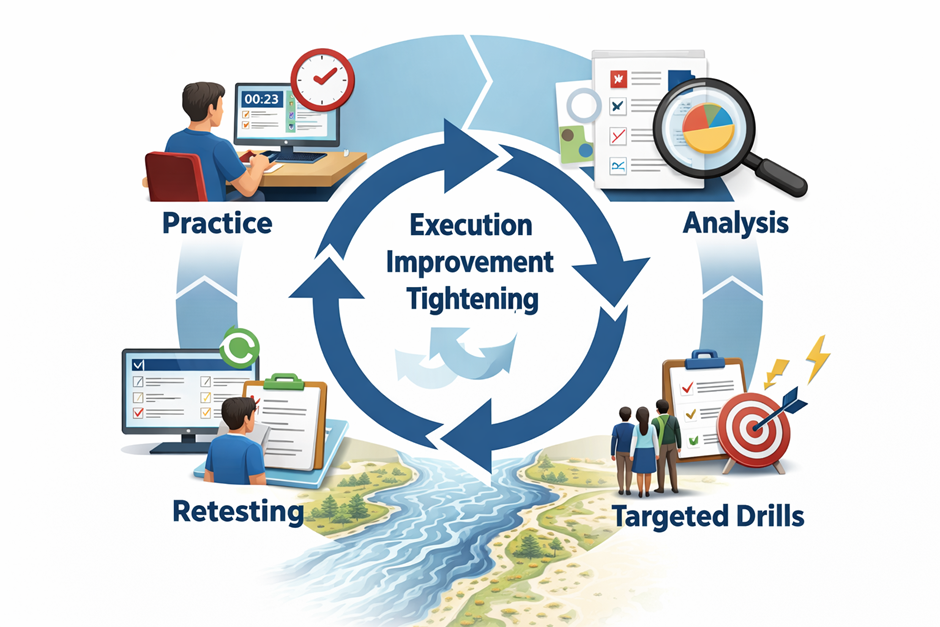
This is also why "diagnostics" often becomes a lead tool. If a diagnostic only tells a student they are weak in a topic, it feels like tuition. Students treat it as free content and move on. But if a diagnostic shows exactly how marks are leaking in an MCQ setting and what drill fixes it, it stops feeling like marketing and starts feeling like value.
The actual CUET opportunity lives here: building a marks conversion engine, not another classroom.
The science versus commerce story is real, but it is often misunderstood.
Many people want a clean split like "70% science, 20% commerce." Public NTA tables do not give an exact stream split because candidates can choose multiple domain papers, so the exam does not map neatly to one stream per candidate.
What we can say, grounded in NTA's 2025 subject-wise registrations, is that science-domain papers draw very large volumes. For example, Chemistry and Physics registrations are each in the high six to seven lakh range, while Economics, Business Studies, and Accountancy are lower but still substantial.
So science dominates by paper selection volume. But this does not automatically mean science is the best monetisation pool.
CUET has a hidden overlap problem.
The JEE and NEET overlap quietly dilutes paid intent in science-heavy volumes.
A large share of science candidates treat CUET as insurance. A backup pathway.
For a student already deep into JEE or NEET preparation, two things are true. Time is already spent, and money is already committed. CUET prep, if it happens, becomes tactical: a few mocks, some familiarisation, perhaps English depending on requirements. It rarely becomes another full coaching purchase.
That is why science volume can look enormous on paper, yet coaching conversion feels softer than expected on the ground.
Commerce may be smaller, but it can be the profit pool.
This is where your intuition is strategically sound, as long as we label it correctly.
We cannot claim "commerce converts higher" as a published fact without stream-wise purchase data. But the logic is compelling: commerce aspirants more often treat CUET as the main race, not insurance. The willingness to pay concentrates when the exam is the primary gatekeeper. Commerce subjects can also be very sensitive to exam-style practice, not because the syllabus is harder, but because execution errors are expensive and repeatable.
So even if commerce is a minority by candidate share, it can punch above its weight in paid intent per candidate.
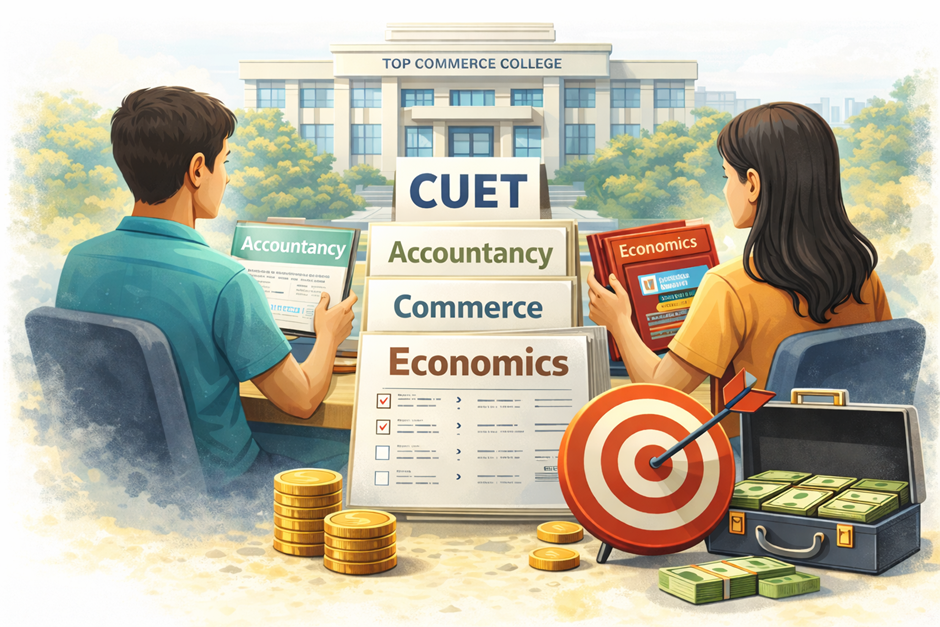
The winning CUET model is not a classroom. It is a marks factory.
The winning CUET model is not a classroom. It is a score engine.
Stop selling syllabus coverage. Sell measurable score lift.
What works in CUET is simple: short, focused score-improvement sprints that fit alongside boards. Mock-to-analysis loops that show exactly where marks are leaking. Training built around repeatable execution errors, not just chapter lists.
Question banks are not the differentiator. The differentiator is the performance system underneath that consistently converts practice into higher scores.
Think less "teaching factory," more "training lab": diagnose, drill, retest, tighten.
CUET did not shrink the opportunity. It clarified it.
Big exams create big coaching markets only when the product fits the bottleneck. In CUET, the bottleneck is not content. It is execution under time pressure.
That is the real opportunity.


