Scientists have developed tiny nano particles that turned carbon dioxide into fuel using light.
As per researchers, carbon dioxide converts into methane, a key building block for many types of fuels, by using only ultraviolet light as an energy source.
After having found a catalyst that can do this important chemistry using ultraviolet light, researchers hope to develop a version that would run on natural sunlight, a potential boon to alternative energy.
Feb 23, 2017
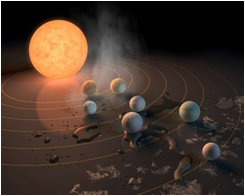
Seven Earth-sized Planets Spotted
Scientists have spotted seven Earth-sized planets, with mass similar to Earth, orbiting around a dwarf star the size of Jupiter, just 39 light years from the Sun.
The planets’ temperature is low enough to make possible the presence of liquid water on their surface.
This is the first time we have so many Earth-like planets found around a star.
Feb 20, 2017
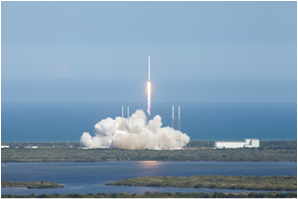
SpaceX Launched its Falcon 9 Rocket
SpaceX launched its Falcon 9 rocket carrying the unmanned Dragon cargo ship from historic NASA launchpad.
The mission was the first to take off from NASA`s historic launchpad 39A, the origin of the pioneering US spaceflights that took astronauts to the Moon in the 1960s and 1970s, as well as the space shuttle missions that ran from 1981 to 2011.
It is the 10th such resupply mission for SpaceX, which along with Orbital ATK has a multi-year contract with NASA to send supplies to the International Space Station.
Feb 16, 2017
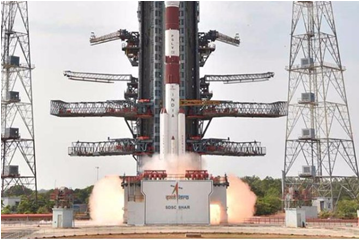
ISRO Sets World Record
Indian space agency ISRO scripted history by successfully launching a record 104 satellites, including country's Cartosat-2 earth observation satellite, in a single mission.
ISRO's Polar Satellite Launch Vehicle PSLV-C37 carrying 104 satellites blasted off from the first launch pad at the Satish Dhawan Space Centre.
About 28 minutes into the flight, PSLV first injected Cartosat-2 series satellite into orbit, followed by the other 103 nano satellites, including 96 from the US, in a gap of about 30 minutes.
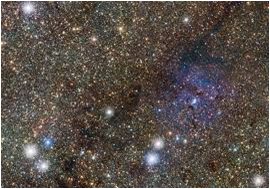
Rare Delta Scuti Pulsating Star
Astronomers have spotted a rare star as big or bigger than the earth's Sun and that is expanding and contracting in three different directions simultaneously.
Situated 7,000 light years away from Earth in the constellation Pegasus, the star is so rare that it's only one of seven identified by astronomers in the Milky Way.
Of those, a mere seven - including the newly-identified one - are the rare intrinsic variable star called a Triple Mode 'high amplitude delta Scuti' or Triple Mode HADS(B), for short.
Feb 11, 2017
NASA Teams Up with ESA
The ESA and NASA are teaming up to take humans to the moon within the next few years.
The European Space Agency (ESA) and aerospace company Airbus have agreed with NASA to build a module for a second, manned mission that will fly around the moon as early as 2021, which will be launched from Kennedy Space Center in Florida, USA.
The manned Orion mission will take humans to the moon for the first time in 50 years. NASA's Orion capsule is also aimed at taking astronauts to Mars and asteroids in the following years.