


 +91-85588-96644


Call Support +91-85588-96644


| Choose Exam Category |

For years, CLAT preparation has rested on a comfortable assumption. The exam is offline, so preparation must also remain offline. Pen, mock tests, OMR sheets, manual checking, long post-test discussions. The system feels familiar and reassuring. It also feels rigorous.
What it does not feel is precise.
This is not a failure of intent or effort. It is a failure of instrumentation. In an environment where competition has intensified and margins between ranks have narrowed, the absence of deep diagnostic insight has become a silent liability.
The exam may still be conducted on paper. Learning, however, does not need to be.
The real problem starts after the mock-test ends
OMR sheets themselves are not the issue. Students already mark responses in bubbles. That part of the process works well and mirrors the final exam.
The breakdown begins after the last sheet is collected. Responses are checked manually. Scores are announced. Ranks are calculated. A detailed discussion follows, often question by question.
What is missing is memory.
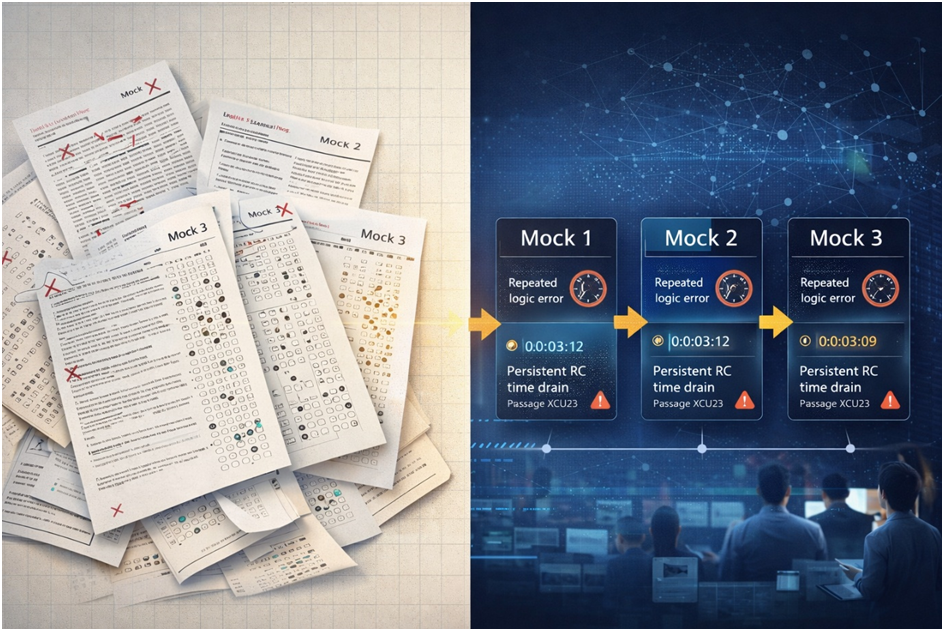
Manual systems struggle to retain and connect information across time. They cannot easily tell whether a student is repeating the same logical error across three mocks, or whether a particular English passage type consistently drains time for most of the batch. Feedback becomes generic not because teachers lack insight, but because the system does not preserve evidence.
Activity is abundant. Acceleration is not.
A small operational shift that changes everything
The most effective CLAT institutes have not changed how students write tests. They have adopted TCY platform to change what happens immediately after.
The shift is simple. Students write the test on paper. They fill the OMR sheet. The OMR is scanned through a cobranded mobile application developed and maintained by TCY. Zero headache. Responses are captured digitally.
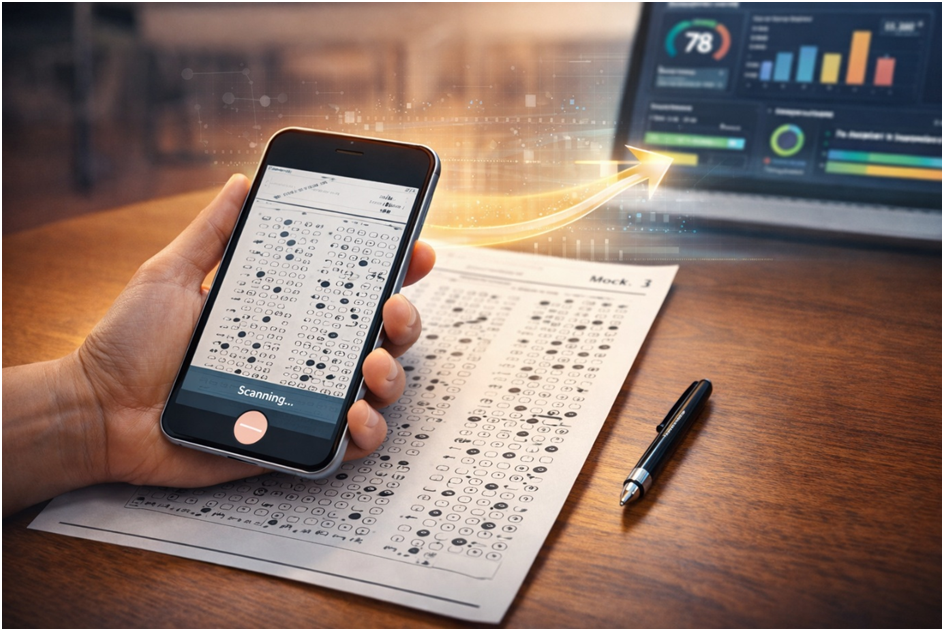
From that moment, the test behaves like an online assessment engine.
Nothing changes for the student. Everything changes for learning.
Once responses are digital, the system can observe behaviour rather than merely record outcomes. This is the difference between knowing a score and understanding performance.
Why marks hide more than they reveal
Traditional paper-based evaluation produces outcomes. Marks, ranks, percentiles. These are useful, but they are blunt instruments.
What they do not show is why marks were lost.
A sophisticated OMR-driven system captures patterns at the question level. Which option a student chose. Whether negative marking clusters around specific question types. Whether students are drawn to the same distractor. Whether certain questions cause risk-taking while others induce hesitation.
Over time, it builds a performance history. Repeating mistakes. Plateaus. Volatility under pressure. Improvement after intervention.
Marks show where a student stands. Patterns explain why.
Without this distinction, most feedback remains descriptive rather than diagnostic.
Why even strong faculty are constrained by paper-only systems
This point is often uncomfortable but necessary. Human judgement does not scale well without data support.
No teacher, regardless of experience, can reliably track error patterns across hundreds of students and thousands of responses over multiple tests. In the absence of structured analytics, feedback converges toward familiar advice. Work on reading. Manage time better. Avoid silly mistakes.
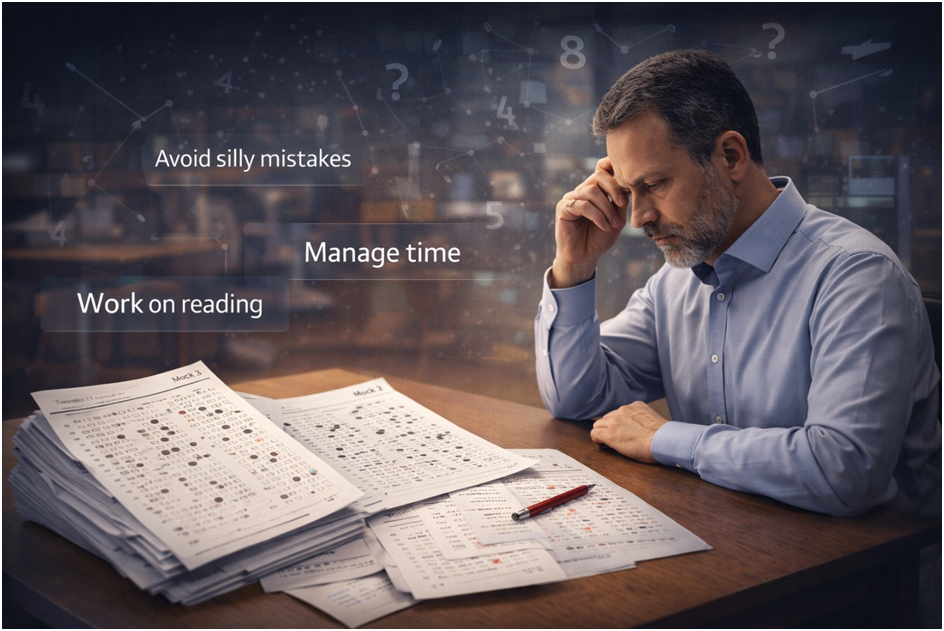
When feedback sounds the same after every mock, it is not because students are not improving. It is because the system cannot surface what is changing and what is not.
Paper-based processes do not weaken teachers. They simply limit what teachers can see.
The overlooked leverage point is the teacher discussion panel
Most institutes focus on student reports. The real leverage lies with teachers.
In a traditional discussion, questions are taken up sequentially. Every question receives attention, regardless of whether it mattered to outcomes. The discussion mirrors the paper.
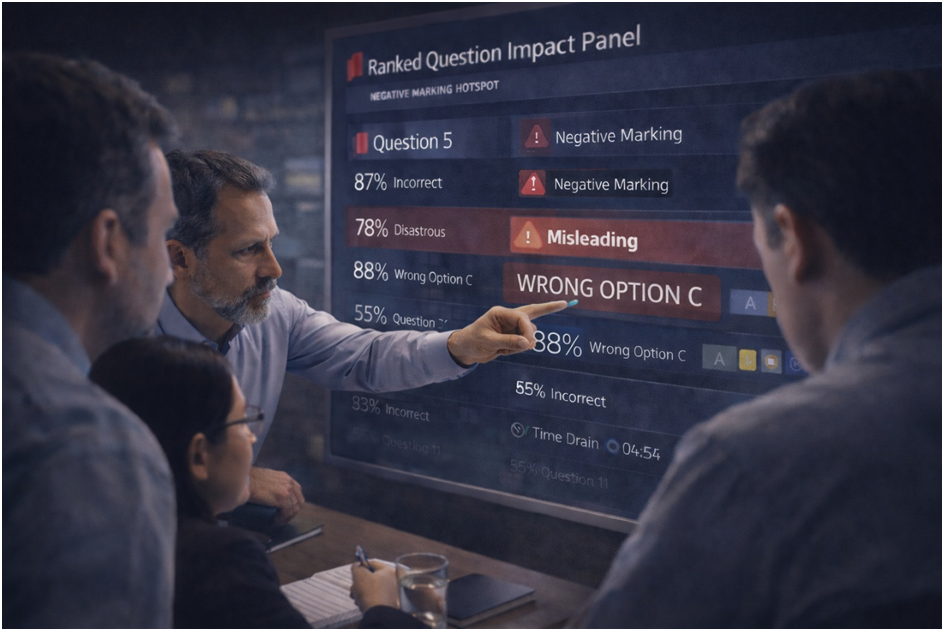
In a data-driven system, the discussion panel looks very different. Questions are automatically prioritised before the discussion begins. The panel highlights those questions that caused the most damage. High error rates. Common wrong options. Disproportionate negative marking. Questions where high scorers benefited and others lost ground.
The discussion follows impact rather than order.
This single change transforms teaching quality. Time is spent on what shaped ranks, not on what merely appeared on the paper.
When teaching shifts from explanation to diagnosis
With prioritised questions, discussions become analytical rather than procedural. Teachers examine why a distractor worked so effectively. Why an apparently easy question was misread. Why certain students attempted a question that top performers skipped. Why time was misjudged.
The focus moves from solving questions to understanding decision-making under pressure.
Strong teachers explain answers. Strong systems decide which answers deserve explanation.
Cohort intelligence changes how institutes think about remediation
Individual analytics help students. Cohort analytics help institutions.
When performance data is aggregated across a batch, patterns emerge that are invisible at the individual level. Certain English passages consistently attract over-reading. Specific legal principle questions are misunderstood across ability levels. Logical sets drain time for most students, not just a few.
At this point, the issue is no longer individual weakness. It is instructional design.
This is a powerful realisation. It shifts the responsibility from student effort to teaching strategy, and that is where scalable improvement becomes possible.
Remediation becomes precise, collective, and effective
With cohort-level insight, remedial work changes form.
Instead of broad instructions to revise a section, institutes can design focused interventions. A legal principles drill targeted at one recurring error. A passage-selection workshop addressing a specific English pattern. A short session on controlling negative marking behaviour. A logic exercise designed around misinterpreted conditions.
Remediation becomes specific enough to work and collective enough to scale.
Progress becomes visible, not anecdotal.
Measuring improvement, not just performance
The true value of digital intelligence lies in verification. After remediation, the system can show whether error rates declined, whether time usage improved, whether accuracy stabilised under pressure.
Teachers learn which interventions work and which need redesign. Academic heads gain clarity without micromanagement. Parents see trendlines instead of isolated scores.

Preparation becomes empirical rather than emotional.
Why this strengthens faculty rather than replacing them
There is a persistent fear that analytics diminish the role of teachers. In practice, the opposite occurs.
Faculty are freed from mechanical checking and repetitive explanation. Discussions become deeper. Junior teachers perform better with structured insight. Senior mentors focus on judgement, strategy, and interpretation.
Analytics do not replace expertise. They amplify it.
The quiet business advantage for institutes
For edtech leaders and coaching owners, the implications extend beyond pedagogy.
A system that combines paper testing with digital intelligence delivers consistent quality across batches. It reduces dependence on a few star faculty members. It allows institutes to scale without diluting outcomes. It provides parents with visible evidence of progress.
In a crowded market, this is not a feature. It is differentiation.
Parents do not pay for tests. They pay for improvement they can see.
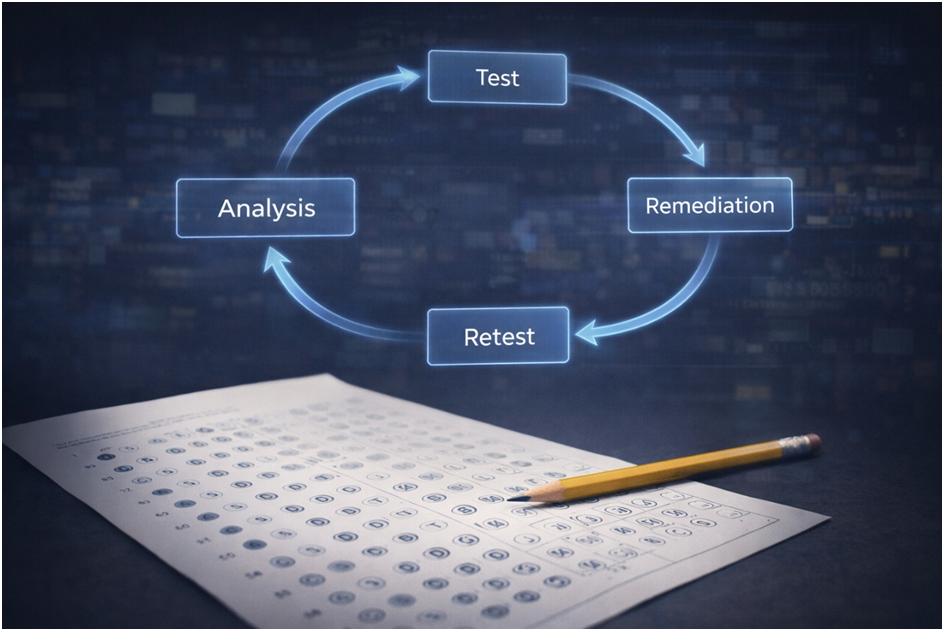
Why the offline argument no longer holds
Offline exams test reasoning, not blindness to data. Competitive preparation today is defined by feedback speed, diagnostic accuracy, and repeatable improvement loops.
Paper-based testing without analytics is no longer a mark of tradition. It is a sign of inefficiency.
A new definition of seriousness in CLAT preparation
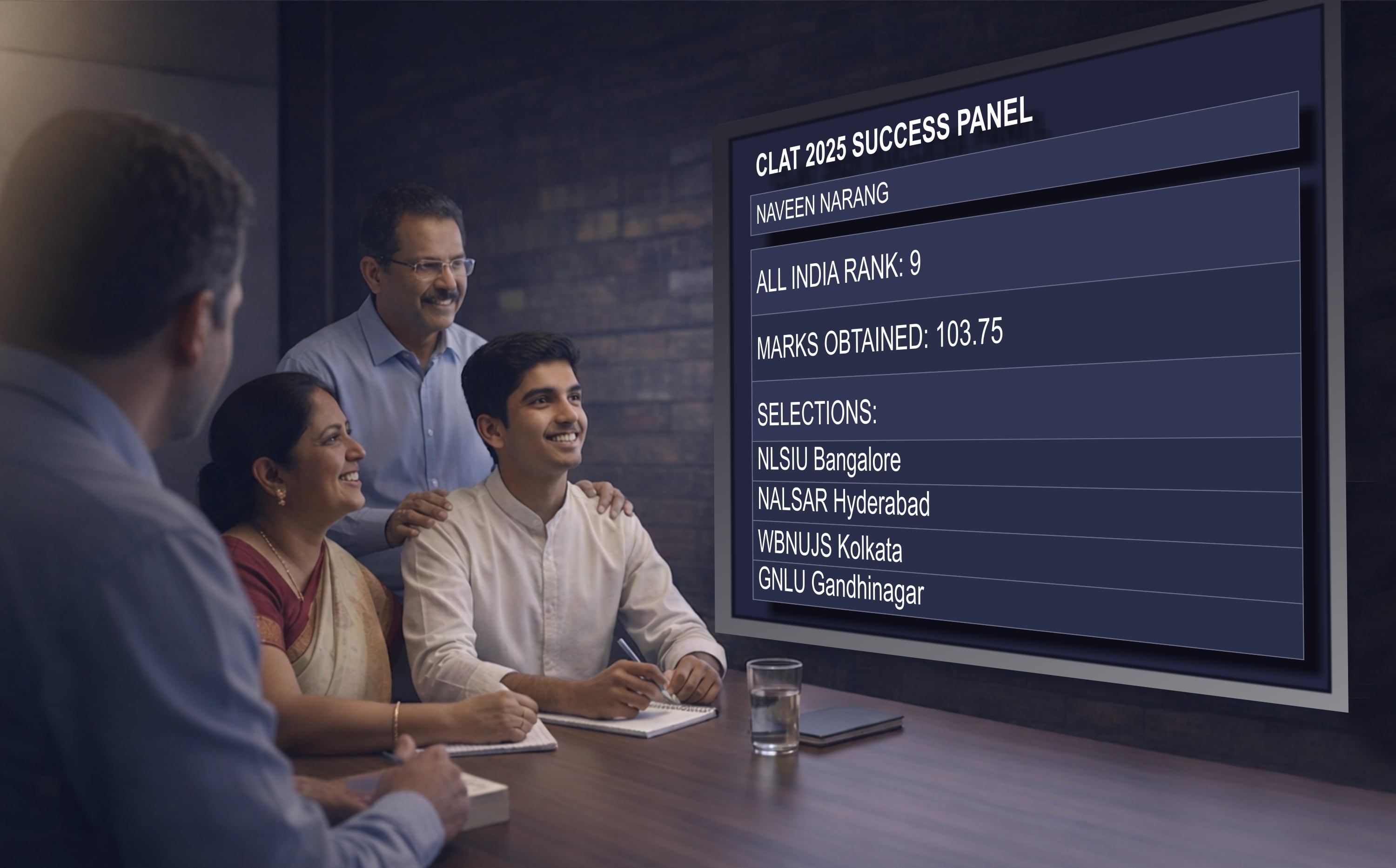
The most credible CLAT institutes of the coming decade will not debate online versus offline. They will build quietly effective systems.
They will test on paper, diagnose digitally, teach selectively, remediate precisely, and track relentlessly.
The real divide in CLAT preparation is not the medium of the exam. It is whether preparation is driven by insight or by guesswork.
Only one of those produces consistent ranks.


