


 +91-85588-96644


Call Support +91-85588-96644


| Choose Exam Category |

The slowdown is real. But it does not mean the world is "moving on" from global education. It means the system is recalibrating.
The OECD's latest migration data points to a shift in patterns, not a collapse in ambition, following the record post-pandemic surge. In 2024, OECD countries welcomed over 1.8 million new international tertiary-level students. That was 13% lower than 2023, but still a very large flow by any historical measure. The decline was concentrated in the four biggest destinations, all of which tightened policy and compliance around the same period: the United States (390,000; -12%), the United Kingdom (389,000; -14%), Canada (213,100; -39%), and Australia (182,000; -22%).
The more important signal lies beneath the headlines. Mobility remains structurally strong, even as destination choices and entry pathways are being edited by policy. OECD tracking shows international student numbers in OECD countries have expanded sharply over the past decade.
1) The "crisis" is a pipeline reset, not a shutdown
If you want the simplest description of 2024, it is this: the pipes narrowed, but the demand did not vanish.
The OECD describes 2024 as the first decline in new international student inflows after three consecutive post-pandemic growth years. What matters for coaching businesses is the shape of that decline. The "Big Four" all fell at once, and the drops were meaningful, especially in Canada and Australia. Yet the volumes are still enormous. In 2024, the United States welcomed 390,000 new international tertiary-level students and the United Kingdom welcomed 389,000, even after the decline.
Now look at the UK, because it is the clearest example of how misleading the word "collapse" can be.
In the year ending September 2025, the UK granted 439,924 sponsored study visas. This was similar to the previous year, though 31% lower than the peak in the year ending September 2023. The story changes the moment you split the total into its two components. Main applicants rose 7% to 419,558, while dependant grants fell 57% to 20,366. Dependants have remained low since January 2024, following rule changes restricting most students' ability to bring them, and dependant grants in the latest year were 87% lower than in the year ending September 2023, before the restrictions.
That distinction matters for India, because India's pipeline is still overwhelmingly student-led, not dependant-led. Indian nationals remained the largest group of UK sponsored study visa main applicants in the same period, with 99,128 visas issued.
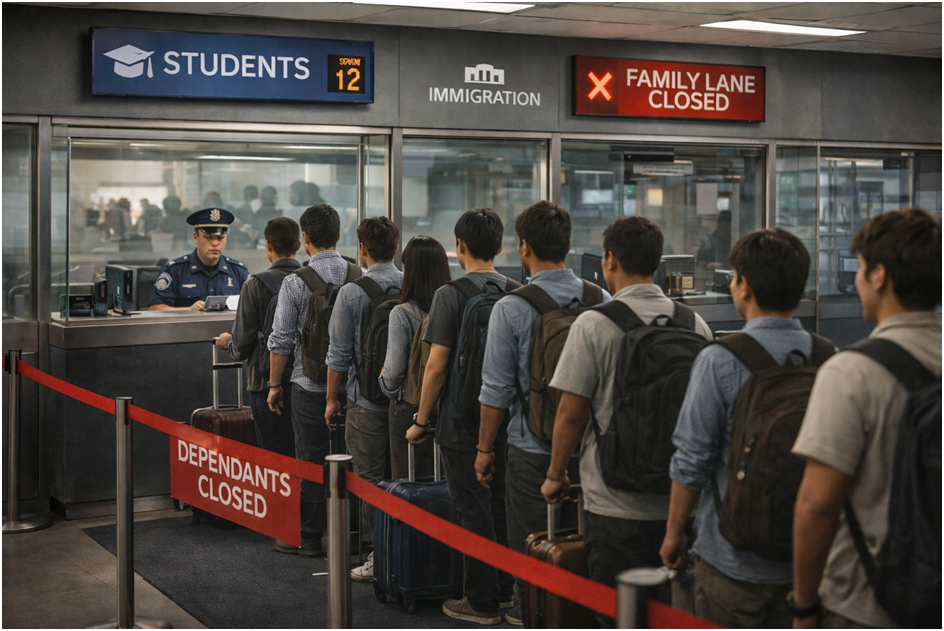
What is changing is not whether students want to go, but what they are allowed to do alongside the degree, and how tightly governments want the system run.
Even within student demand, the UK is seeing a shift in who is coming. UK data shows the recent surge was mainly driven by master's-level study, accounting for over 60% of study visas over the last five years. But in the year ending September 2025, master's grants fell 19% to 256,303. Bachelor's remained a large, steadier base at 114,012 grants, about 28% of the total.
Put together, a clearer and more investable narrative emerges: governments are tightening the high-volume parts of the funnel that they trust less, while the core desire for international education remains intact.
2) When one door tightens, students reroute, they do not disappear
If 2024 taught the industry anything, it is that international demand does not vanish. It migrates.
The OECD's 2025 outlook is blunt: yes, new international student inflows fell in the Big Four. But flows to the rest of the OECD rose 5%. In other words, the centre of gravity did not shrink. It shifted. The OECD flags Denmark, Korea, New Zealand, and Sweden as standout gainers, each posting 14% to 19% increases. It also notes that Japan welcomed about 167,000 new international tertiary-level students in 2024, up 20% in a single year.
Europe reinforces the same point. The decline is concentrated in a few heavily scrutinised destinations, while other countries continue to expand their intake and absorb redistributed demand. In that rebalancing, France, Spain, and Germany remain among the key European magnets for international students.
Germany is the cleanest example of what this shift looks like on the ground for India. DAAD reports that Indian student enrolment in Germany reached 59,419 in the 2024/25 winter semester, up from 28,905 in 2020, which is more than doubling in five years. That is not a marginal shift. That is a second pipeline forming in parallel to the traditional Big Four routes.
And the United States, often lumped into the "slowdown" story, is not collapsing on the fundamentals. Open Doors reports 1,177,766 international students in the US in 2024/25, and India at 363,019, up 10% year on year.
For coaching centres and visa consultants, this is a different kind of risk. It is destination risk, not category risk. Demand is not disappearing. It is being redistributed toward destinations with clearer economics, tighter compliance, and more predictable post-study outcomes.

3) Australia shows the pattern clearly: slower new intake, strong continuing base
Australia's official Provider Registration and International Student Management System (PRISMS) based monthly summary makes the mechanics visible. In the year-to-date (YTD) October 2025 period, 833,041 international students studied in Australia, just 0.3% lower than the same period in 2024. But intake slowed. The number of new students was 190,799, down 15%, and commencements were 447,014, also down 15%.
Here is the nuance investors in this sector should notice: while overall numbers remained broadly steady, the composition shifted. Total international student enrolments were 1,025,807, down 2% year on year. Within that, Higher Education enrolments still grew 10%, and Schools grew 4%, while all other sectors declined, most sharply English Language Intensive Courses for Overseas Students (ELICOS), down 37%.
This is not just a volume story. It is a pathway story. Australia is seeing fewer short, language-first entries and a stronger tilt toward degree-linked enrolments.
The same official summary also shows how concentrated the market remains, which matters for India-focused businesses. A large share of Australia's international students continues to come from a small number of source countries, with China and India the two largest cohorts. Within Higher Education enrolments, the biggest level is Masters by coursework, followed by Bachelors.
Commercially, this is why the industry feels pain first when "new intake" slows. New commencements drive fresh test-prep demand. But a large continuing base still creates repeat demand pools that many centres under-monetise, especially when rules tighten and students become more careful. This includes re-tests to hit visa, progression, or job-linked thresholds, post-arrival language support for academic performance and employability, and pathways that feed into work and longer-term permanent residency (PR) planning, where English proof often becomes a gating factor.
4) The most underused argument: countries can't afford to "turn off" international education
Politicians may talk tough. But economics forces a simpler reality. Governments can tighten, re-rank, and rebuild guardrails, but they rarely switch off a sector that behaves like an export industry, a university funding engine, and a local jobs pipeline.
Australia is the clearest proof. From the trade side, the Australian Bureau of Statistics (ABS) reports that education-related travel services rose 40.4% to A$51,032 million in 2023–24, exceeding pre-pandemic levels. ABS also shows how concentrated this export engine is: China remained the largest partner, while India rose A$2,956 million (49.8%) in the same year.
When a line item rebounds this hard, policy usually moves toward calibration. That means caps, tighter compliance, sharper definitions, not cancellation.
Canada tells the same story in a different currency. Global Affairs Canada estimates that in 2022, international students spent C$37.3 billion, translating into about a C$30.9 billion contribution to GDP. It also notes that spending more than doubled from C$15.5b in 2016 to C$37.3b in 2022.
The US numbers are just as blunt. NAFSA's national estimate puts the 2024–25 contribution at US$42.9 billion, supporting 355,736 jobs.
And in the UK, the net-benefit case is unusually persuasive. A widely cited London Economics analysis published via HEPI estimates the 2021/22 cohort generated £41.9 billion (gross) and £37.4 billion (net), with public costs of around £4.4 billion, implying a very high benefit-to-cost ratio.

So yes, rules tighten. But look at where they tighten: dependants, low-value pathways, credibility checks, enforcement. When the economic footprint is this large, the policy centre rarely becomes "shut it down." It becomes "make it cleaner, controlled, and defensible." That is exactly the kind of phase where well-run coaching centres and serious visa consultants gain share.
5) IELTS and PTE are no longer just "study abroad exams." They're mobility infrastructure.
In India, demand for IELTS and PTE still rises and falls with study-abroad sentiment. IDP's own FY24 reporting shows this clearly. IELTS volumes were down 18%, and IDP attributes the decline primarily to India, linking it to regulatory and visa uncertainty in key destinations. But the more important insight is what happened at the same time outside India. IELTS volumes were up 12% in the rest of the world. That is not what a dying market looks like. It is what a redistributing market looks like. Demand did not disappear. It shifted by destination and pathway.
That shift leads to a practical strategic point. IELTS and PTE demand does not come from one engine. It comes from two.
The first engine is the admissions pipeline. This is where sentiment matters most. When student visa rules tighten, counselling slows, applications soften, and Indian test volumes wobble.
The second engine is the mobility pipeline, and it is structurally steadier. These tests are embedded inside government systems as formal compliance requirements. This is where most coaching centres and visa consultants underplay the opportunity.
In the United Kingdom, the Secure English Language Test (SELT) route is explicitly tied to visa and citizenship applications. GOV.UK shows this guidance was last updated 5 January 2026. IELTS for UK Visas and Immigration is listed as accepted proof of English for those who want to live, work, or study in the UK, and Pearson positions PTE Academic UKVI as an approved SELT. In Australia, the Department of Home Affairs states that English evidence must come from an approved test taken in a secure testing centre, and it notes that the list of approved tests changed from 7 August 2025. In Canada, IRCC's Express Entry documentation lists accepted language tests and includes PTE Core, alongside IELTS General Training and CELPIP-General.
So yes, when student visa rules tighten, Indian test volumes can swing. But that swing does not mean IELTS and PTE lose relevance. It means the market stops being one simple story and becomes a more complex one: multiple destinations, multiple visa categories, and higher consequences for documentation and score strategy. In that environment, the centres and consultants who can serve both the admissions pipeline and the mobility pipeline do not just survive the phase. They widen the gap.

6) "It's a phase" is not wishful thinking. It's how the IELTS business itself explains it.
IDP's FY24 reporting is unusually candid about what changed. Policy moves in the UK, Canada, and Australia did not erase intent. They shook confidence. IDP's diagnosis is direct: test takers "deferred their international ambitions until a more certain regulatory environment returns."
That single framing shifts the entire conclusion. This is not a world where students no longer want to go abroad. It is a world where students want fewer surprises. They are delaying decisions, double-checking eligibility, and choosing destinations with clearer rules.
The OECD's data reinforces the same point at scale. The Big Four slowed, but flows to the rest of the OECD rose 5%, with some of the sharpest gains in Denmark, Korea, New Zealand, and Sweden. Demand did not collapse. It re-routed.
So the question for coaching businesses is not whether demand exists. It is whether your model is built to capture demand when it shifts.
What coaching owners and visa consultants can do right now
1) Sell "global mobility English," not just "admissions English."
In India, students will remain your main volume driver. But resilience comes from building lanes where English is a formal government gatekeeper. The UK's Secure English Language Test (SELT) guidance is explicitly tied to visa or citizenship applications and was last updated 5 January 2026.
Australia's Department of Home Affairs requires English evidence from an approved test taken in a secure testing centre, and it notes the approved-test regime changed from 7 August 2025.
This is how you stop being hostage to one intake season.
2) Go multi-destination by design, not as an afterthought.
The OECD is effectively signalling the new map. "Alternative destinations" are no longer optional. They are becoming core pipelines. Build destination-specific counselling, score strategy, and documentation playbooks around a wider set of routes, because that is exactly how students are behaving now.
3) Sell certainty in an uncertain year. This is where premium players win.
When rules tighten, the product is not more classes. The product is clarity. The right test. The right version. The right proof. The right score plan for the pathway. IDP's word "deferred" is not a decline signal. It is a demand signal for structured guidance.
This phase will not reward louder marketing. It will reward centres that reduce student risk: correct test choice, correct documentation, and correct score strategy.


