+91-85588-96644


+91-85588-96644


| Choose Exam Category |

Something significant is shifting in India's MBA preparation market. CAT 2025 registrations dropped by nearly 12 percent from the previous year, yet more than 2.6 lakh students still walked into the exam hall. The interest is large, but the behaviour underneath it has changed. Coaching centres that once struggled to accommodate overflowing batches now report half-filled rooms. Enquiries come in, but conversions hesitate. Every coaching owner can sense the drift, even if the reasons feel hard to pin down.
This is not a temporary fluctuation. It is a structural realignment of the MBA talent pipeline, and three invisible forces explain exactly where your students have gone.
1. The Middle of the Pyramid Has Collapsed While Everyone Looked Away
For two decades, the Indian MBA market resembled a three-layer pyramid.
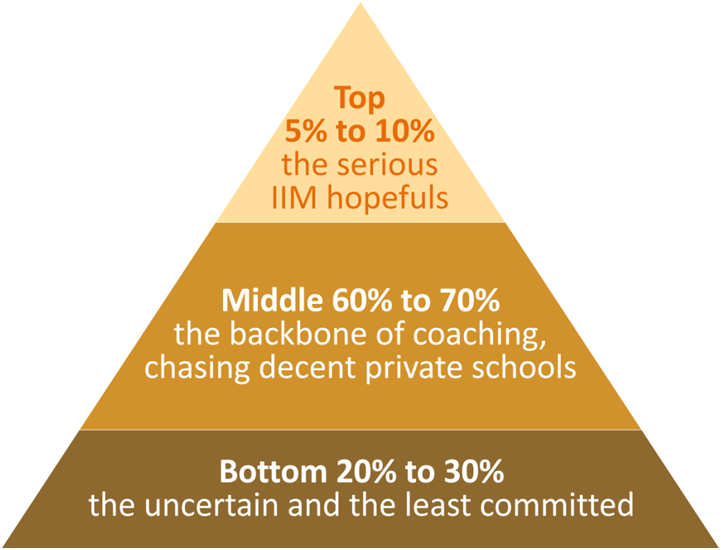
The middle segment was the engine that powered traditional CAT coaching. They enrolled early, bought full-year programmes, and filled weekend batches. This group has quietly thinned.
The harsh economics of the average MBA have become public knowledge.
India now has more than 3,000 B-schools and produces roughly 3.5 to 3.8 lakh MBA graduates a year. Various placement and industry analyses suggest that only about 10 to 15 percent of them move into roles that genuinely use management skills, while a large share are absorbed into low-paying generic jobs. At the same time, weaker institutes have been shutting or shrinking, and salary curves flatten quickly once you step outside the top 30 to 40 schools.
The middle aspirant has finally connected the dots.
If a degree cannot reliably shift their career trajectory, the premium tuition no longer feels like an investment. It feels like risk.
This segment has been slipping away for years. It is the most important explanation for why classrooms look emptier even though registrations appear strong.
2. Students Have Not Abandoned CAT. They Have Abandoned the Old MBA Timeline
There is a widespread belief among institutes that students no longer want an MBA. The reality is more nuanced.
Students still want strong careers. They simply want certainty early and are unwilling to wait for years before they see clarity.
You can see this shift in their choices.
CUET attracts between 13 and 17 lakh aspirants every year.
IPMAT and five-year integrated programmes are booming.
Colleges are running their own aptitude, communication, and placement bootcamps.
Companies now hire fresh graduates into business analyst, operations, consulting support, and data roles.
A 20-year-old can realistically tell herself:
I can get a decent role straight after graduation. Why should I pause for two years unless I am confident of a top B-school?

Students still want MBAs, but they want them at the right point in their career. They are simply unwilling to commit early unless the payoff feels real.
3. CAT Has Turned Into a Low-Cost Call Option Instead of a One-Year Commitment
Falling seriousness around CAT preparation is often misunderstood as declining interest. In reality, it reflects a shift in how students perceive risk. The CAT application fee has become a low-cost hedge, not a signal of long-term commitment.
For many students, CAT functions like a small financial bet on a possible future.If things fall in place, great. If not, they can continue with CUET or IPM, take campus placements, join coding or analytics bootcamps, or pursue a specialised PG diploma.
The real competitor for coaching institutes is not another institute. It is the growing attractiveness of staying noncommittal.

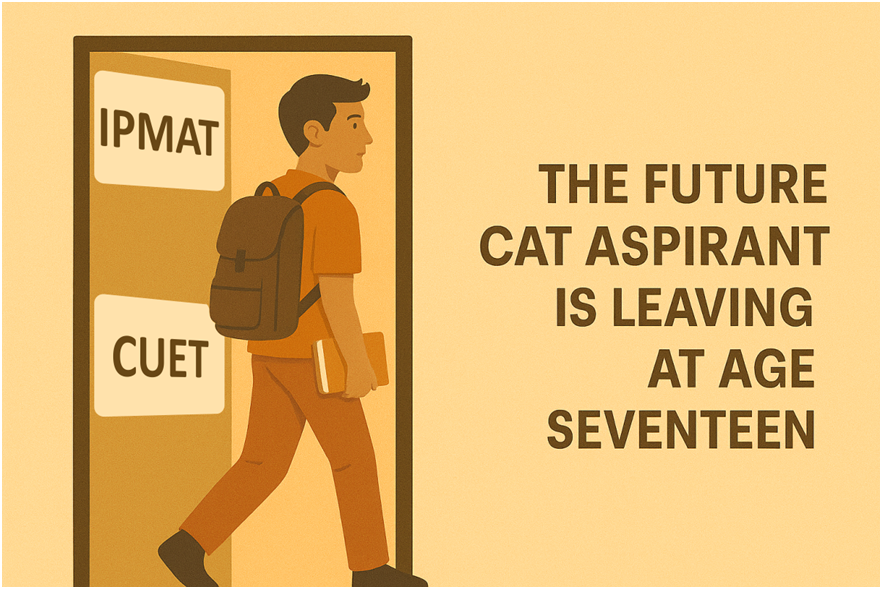
4. The Future CAT Aspirant Is Leaving at Age Seventeen
A quiet but powerful shift has taken place in the feeder base.
CUET and IPM siphon away a large share of serious Class 12 students.
These are the students who used to enter the CAT ecosystem at age 21 or 22. Now they lock in university seats or integrated management pathways early.
By the time they reach the typical CAT age, they are already inside structured UG to career pipelines and have no reason to circle back to CAT coaching.
This is one of the biggest reasons your future batches feel lighter.
5. The New Competitor Is Not Online Coaching. It Is the College Placement Cell
Across the country, colleges are building their own ecosystem of aptitude modules, soft skills labs, resume workshops, GD-PI coaching, and company-linked training.
Students now receive the first layer of CAT-style value without paying anything extra. Once that foundation is created inside the college, only the top segment seeks separate training.
This has quietly eaten into walk-in traffic and reduced the role of the neighbourhood coaching centre as the default first choice.

6. The Ambition Stack Has Shifted From Percentile First to Portfolio First
Today's student does not optimise for one outcome. They manage multiple career bets at once.

CAT preparation is one chapter in a larger story. This is why year-long programmes feel too heavy for the modern aspirant. The student wants shorter, sharper bursts that fit into a busy, opportunity-rich portfolio.
7. A Changing Demographic: More Women and More Non-Metro Aspirants
The CAT applicant pool is shifting. There are more women candidates, more aspirants from Tier-2 and Tier-3 cities, and more first-generation professionals.
This group values safety, flexible timing, hybrid models, mentorship, and outcome visibility. Traditional batch formats that demand high daily commitment often feel misaligned with their lives.
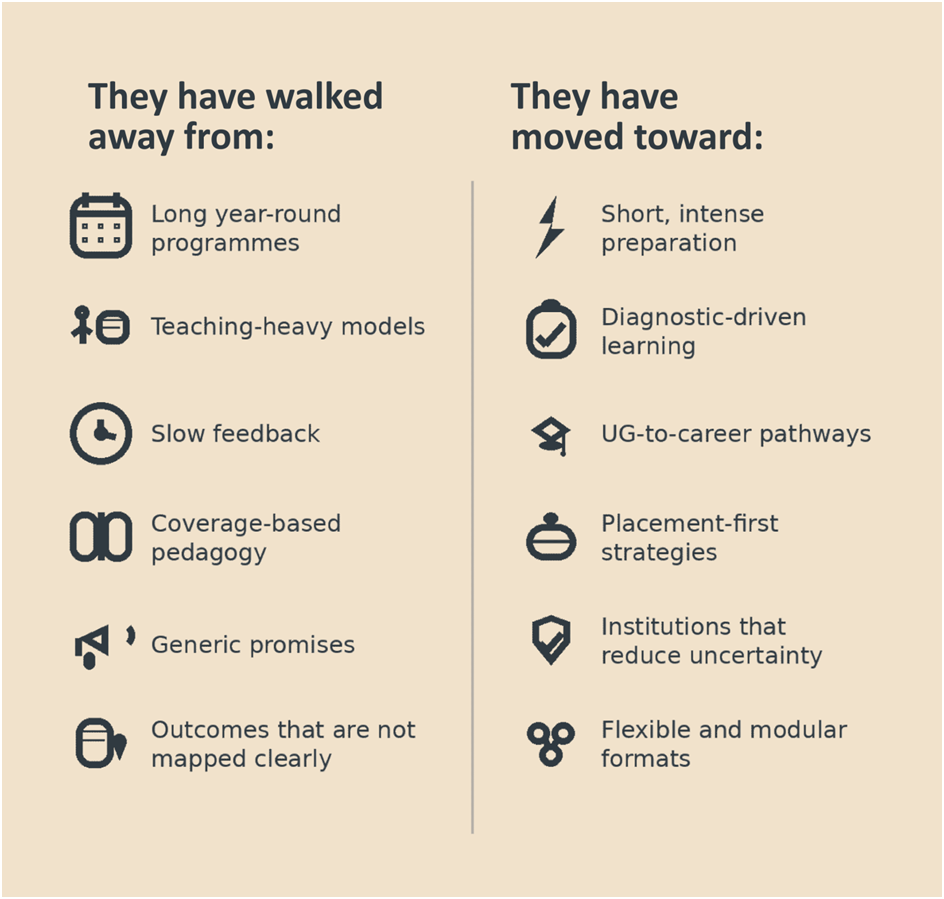
Where Have the Students Gone?
CAT coaching is not dying. The business model from the previous decade is.
The Strategic Roadmap for Coaching Owners
A. Rebuild the Product for a Compressed Market
1. Compress the Offering
The market rewards speed.
Offer 90-day CAT sprints, 60-day DILR bootcamps, 45-day VARC accelerators, and 30-day WAT–PI conversion labs.
Shorter cycles lead to better uptake, more batches, and stronger economics.
2. Lead With Certainty
Students want clarity from day one.
Give them a baseline percentile, a target pathway, a time-to-improvement forecast, and a college possibility map and a monthly National CAT (NATCAT) Score.
This becomes your new conversion engine.
3. Build a Resolution-of-Uncertainty Loop
The learning loop must look like this:

This is what makes physical coaching valuable again.
B. Expand Beyond MBA in a Smart Way
1. Own the 16 to 22 Age Funnel
Your skills map naturally to CUET, IPMAT, CLAT, BBA entrances, and campus placement preparation.
This pipeline is larger and more stable than the MBA segment.
2. Build a Strong B2B Practice With Colleges
Colleges need aptitude prep, GD-PI modules, communication labs, dashboards, and finishing programmes.
This reduces dependence on walk-in students.
C. Differentiate Where Online Platforms Cannot
1. Local Mentorship
Local alumni and success stories build trust that online videos cannot replicate.
Create a community of mentors, storytellers, and interview guides.
2. Build a Conversion Lab
Live mock interviews, case simulations, WAT writing clinics, and recorded feedback create visible value for parents and students.
A Final Word
Your student numbers did not fall. Your value proposition became outdated.
Students did not reject classrooms. They rejected uncertainty, slow feedback, rigid formats, and promises that felt vague.
Rebuild your offering around speed, clarity, diagnostics, and career-mapped outcomes.
Do this with conviction and your classrooms will fill again.
The MBA dream is still alive. Students are simply choosing a different doorway.
Your task now is to redesign the doorway in a way that fits the world they live in today.