+91-85588-96644


Call Support +91-85588-96644



Templates have always occupied a complicated place in PTE preparation.
Used intelligently, structure helps students organise ideas, manage time and communicate clearly. But when memorised language begins replacing task-specific production, preparation starts measuring something very different from language ability.
That creates a difficult problem for AI-based evaluation:
How do you distinguish normal formulaic language from a response that is substantially built on reusable scaffolding?
This question has driven a major evolution in TCY's template-detection work.
What began as identifying familiar phrases and structures has developed into a multi-signal, task-aware system designed not only to catch templates, but also to avoid penalising genuine responses.
Consider a student who writes:
"Firstly, universities can work with parents and teachers. Secondly, students can receive additional support. Thirdly, universities can provide flexible options."
A simple detector may see Firstly, Secondly, Thirdly and become suspicious.
But the student is clearly producing task-specific content.
Now compare that with:
"This provides significant information regarding the topic, highlighting several key aspects. Overall, this will contribute to the general welfare of the university."
It may sound more polished.
But most of it could survive almost unchanged if the topic were replaced.
That is the distinction that matters.
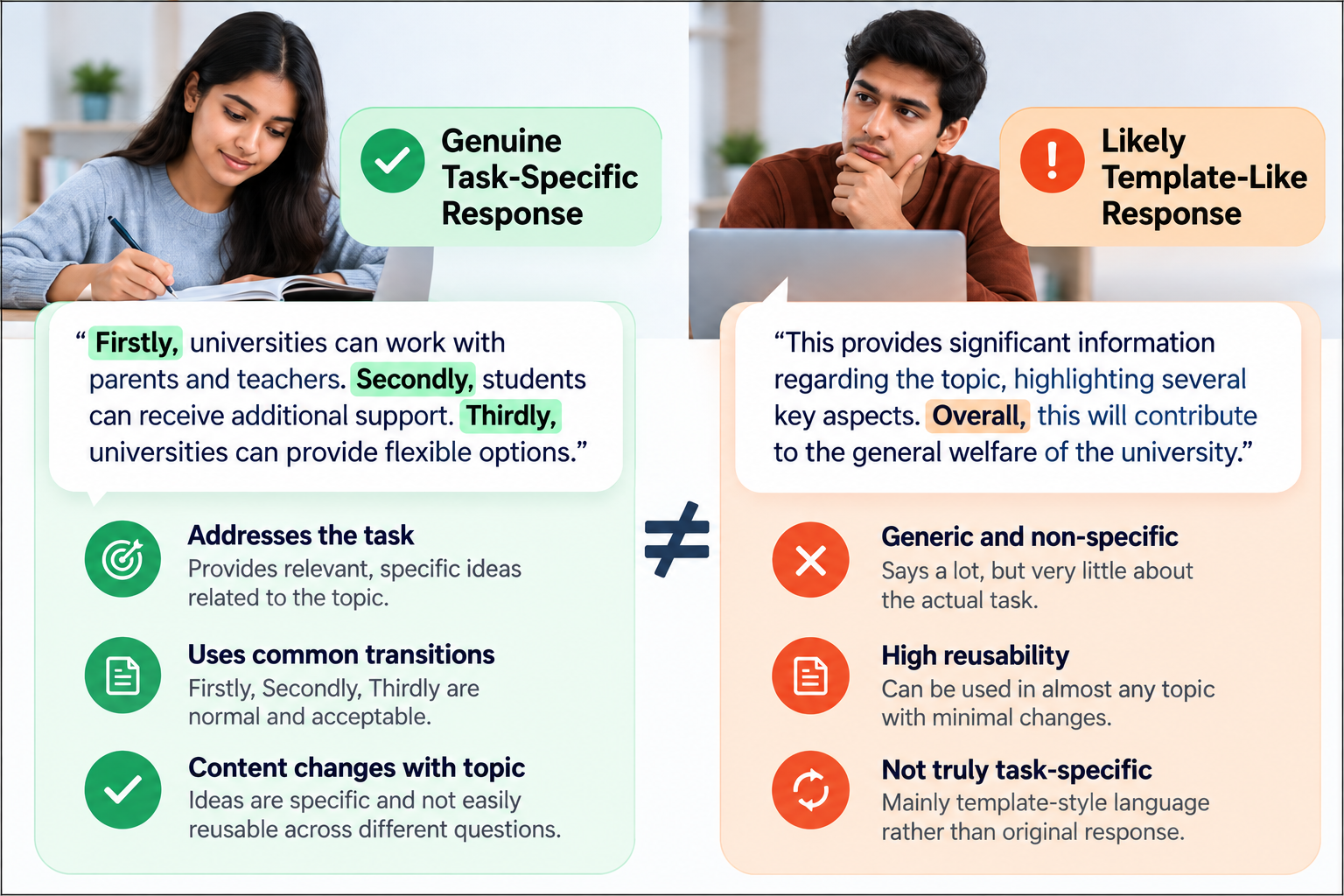
Common phrases are not the problem. Highly reusable language that replaces genuine task-specific production is.
And making that distinction reliably is considerably harder.
Poor English can easily look suspicious to an automated system.
A genuine learner may repeat words, use generic vocabulary, misread a chart, rely on simple transitions, write fragmented sentences or make grammatical mistakes.
None of these proves template use.
This became an important design principle in TCY's system:
weak language must not be mistaken for memorised language.
The detector therefore looks for positive evidence of reusable scaffolding rather than treating language weakness itself as evidence.
It also asks whether the suspicious language is substantial enough to characterise the response.
One conventional sentence is very different from a response in which most of the wording could have been prepared before the student saw the question.
TCY's current approach brings together several layers of evidence.
The system can recognise previously observed templated behaviour even when students make surface changes.
Changing a noun, replacing an adjective or rearranging part of a sentence does not necessarily change the underlying structure.
The more important question is:
Could this framework be reused across several unrelated prompts with only minor substitutions?
This allows detection to move beyond exact phrase matching towards the linguistic skeleton underneath the response.
Template detection cannot use the same assumptions everywhere.
In Describe Image, expressions such as "the graph shows", "the highest value" and "overall" are completely normal.
In Write Email, greetings, closings and organisational expressions are expected.
So TCY evaluates recurring language in the context of the task.
A phrase is not suspicious merely because it is common. The surrounding structure, its reusability and how much of the response it controls are far more important.
A student can produce fluent English while saying surprisingly little about the actual task.
That makes prompt relevance another useful signal.
For Describe Image, for example, TCY is using lexical relevance measures, including Jaccard-style content similarity, as one supporting mechanism for identifying responses with very little connection to the stimulus.
But this signal is deliberately not used alone.
Students may paraphrase, use synonyms, describe numerical relationships or introduce relevant vocabulary that does not appear verbatim in the prompt.
The decision therefore comes from converging evidence rather than a single threshold or phrase.
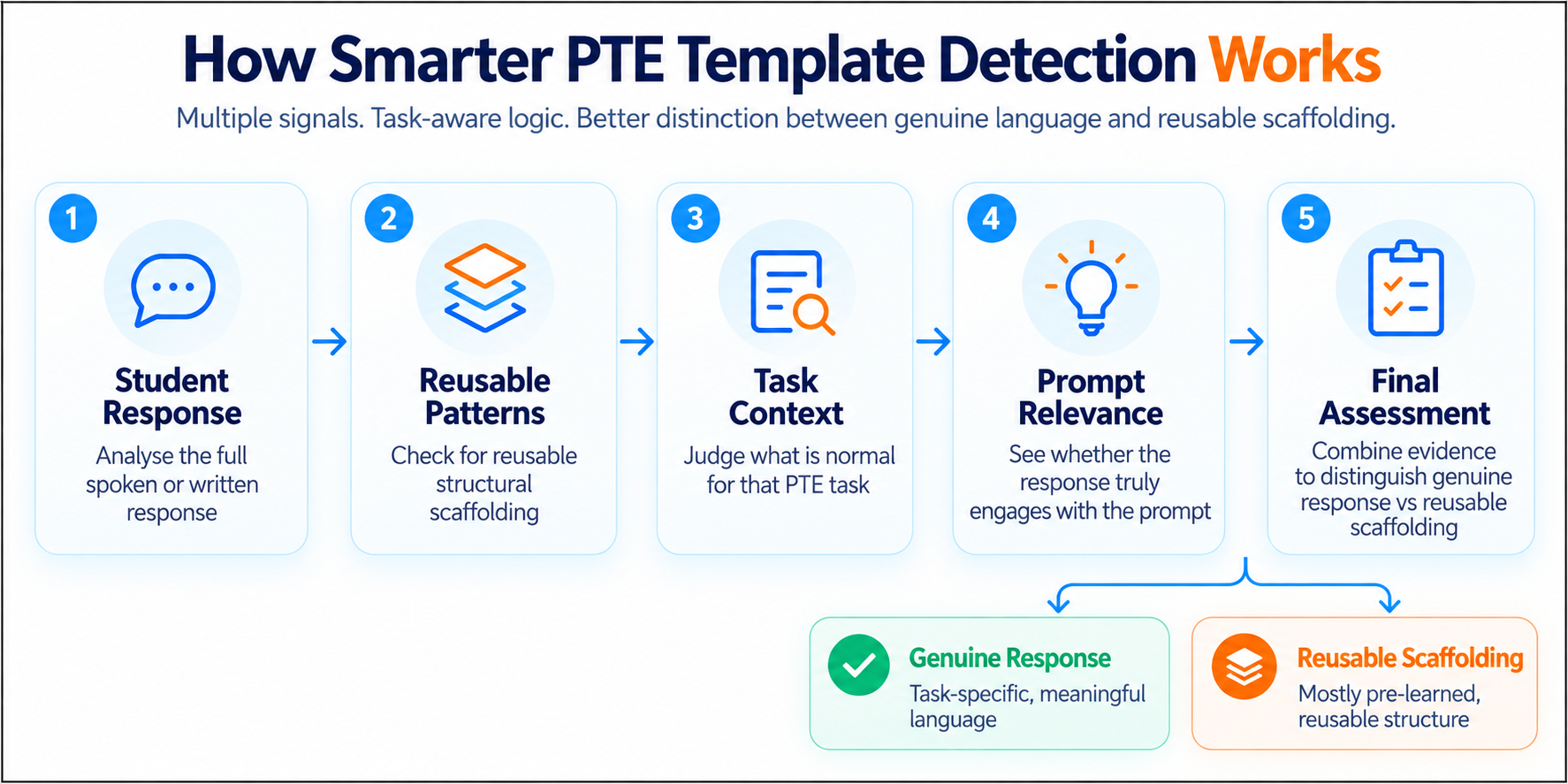
The real opportunity goes beyond displaying:
Template detected.
A more sophisticated system can begin separating very different learner behaviours.
It can distinguish a student who simply uses conventional transitions from one who inserts prompt words into a largely fixed skeleton.
It can separate a learner who has memorised one opening sentence from one whose entire response depends on reusable language.
And it can identify responses that sound fluent but contain very little task-specific content.
For a trainer, those are completely different problems.
And they require completely different interventions.
The objective is therefore not to eliminate structure from PTE preparation.
It is to identify the point at which structure begins replacing actual language production.
TCY's template-detection architecture is being developed across Describe Image, Respond to a Situation, Write Email, Essay Writing, Retell Lecture, Summarise Group Discussion, Summarise Spoken Text and Summarise Written Text.
This matters because templated behaviour does not look identical across these tasks.
A perfectly legitimate structure in one item type may become suspicious in another.
The future of template detection is therefore unlikely to be a universal database of prohibited phrases.
It will need to be task-aware, contextual and evidence-driven.
Generative AI has made sophisticated templates easier than ever to create, modify and personalise.
That makes the old question increasingly inadequate:
"Have we seen this sentence before?"
A stronger system needs to ask:
"How much of this response was genuinely constructed around this task?"
That is the direction TCY is pursuing.
The goal is simple to state, even if it is technically difficult to achieve:
detect reusable scaffolding without penalising genuine language.
For PTE trainers, that could make template detection far more than an integrity check.
It could become a diagnostic tool that reveals how a student is constructing a response, where genuine production is happening, and where memorised language may be masking the real learning need.