


 +91-85588-96644


Call Support +91-85588-96644


| Choose Exam Category |

A student finishes a SAT mock and gets a 1170.
Within seconds, another question follows.
Why 1170?
Was Math the problem? Have Reading and Writing actually improved? Is there a skill that keepscausing errors? Is the student running out of time? And, perhaps most importantly, what shouldhappen before the next mock?
Those questions led us to build ENA Insights for SAT.
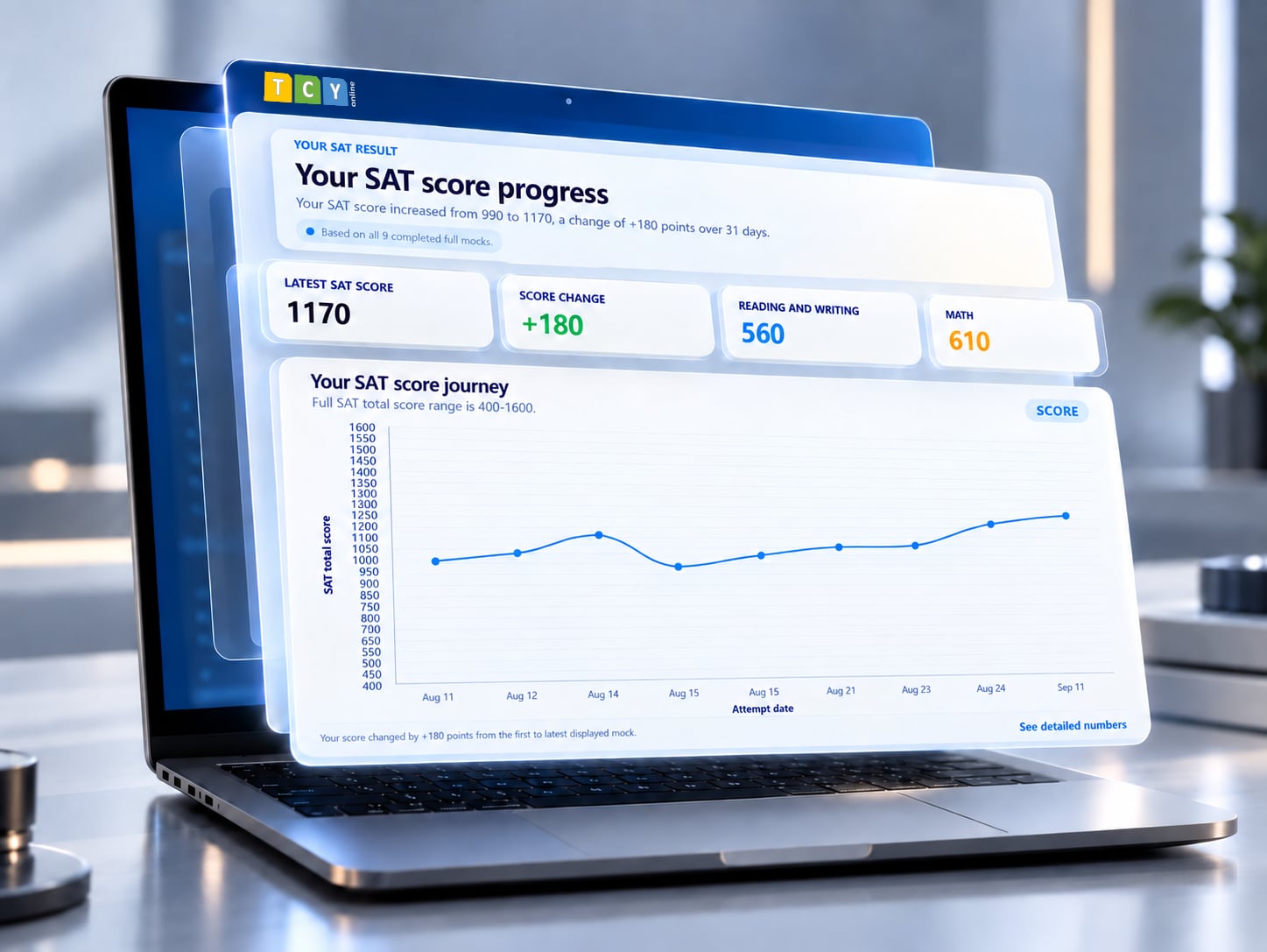
The idea was simple: a student should be able to ask questions about their own SAT performance and get answers grounded in what they have actually done.
Consider two students who both get 75 percent of their questions right.
The numbers look similar.
On an adaptive SAT, the story may not be.
Their module paths may be different. The difficulty of the questions they encountered may be different. One may have struggled toward the end of a module. The other may have made errors much earlier.
So ENA Insights cannot stop at accuracy.
It looks at Math ,Reading and Writing separately, then goes deeper into domains, skills and subskills. It can examine performance by difficulty and module, look at pacing and question position, and identify where time is being spent without producing results.
That allows a student to ask something far more useful than, "What was my score?
"They can ask:
"What is pulling my Math score down?"
Or:
"Which Reading and Writing skills should I work on before my next mock?"
This became one of the most important principles behind ENA Insights.
Suppose a student answers two questions from a skill and gets one wrong.
Accuracy: 50 percent.
It would be easy to label that skill a weakness.
It would also be questionable.
ENA Insights looks at how much evidence exists before making that judgement. A pattern supported by repeated questions and attempts is treated differently from an early signal based on very little data.
In other words, it tries to distinguish between:
"You got this wrong."
and
"This keeps going wrong."
For a trainer, that distinction is important. The second observation may deserve intervention. The first may simply deserve another question. The goal is not to label every imperfect result as a weakness. The goal is to find the patterns that deserve attention.
Full mocks remain central because they show how a student performs across the SAT under comparable conditions.
But preparation happens between mocks.
Students take sectional tests. They practise individual areas. They revisit weaknesses.
ENA Insights uses that additional evidence without pretending that every type of test means the same thing.
Full mocks provide the basis for overall score trends and target analysis. Sectional and skill-level work adds context. It uses both, but it does not pretend they mean the same thing.
That separation matters.
A mock can tell us that Math has stopped improving.
Practice data may help explain why
The visible experience is intentionally simple.
There is a question box.
A student does not have to decide which report to open or which chart to inspect. They can ask:
"How has my Math score changed?"
"What are my weakest skills?"
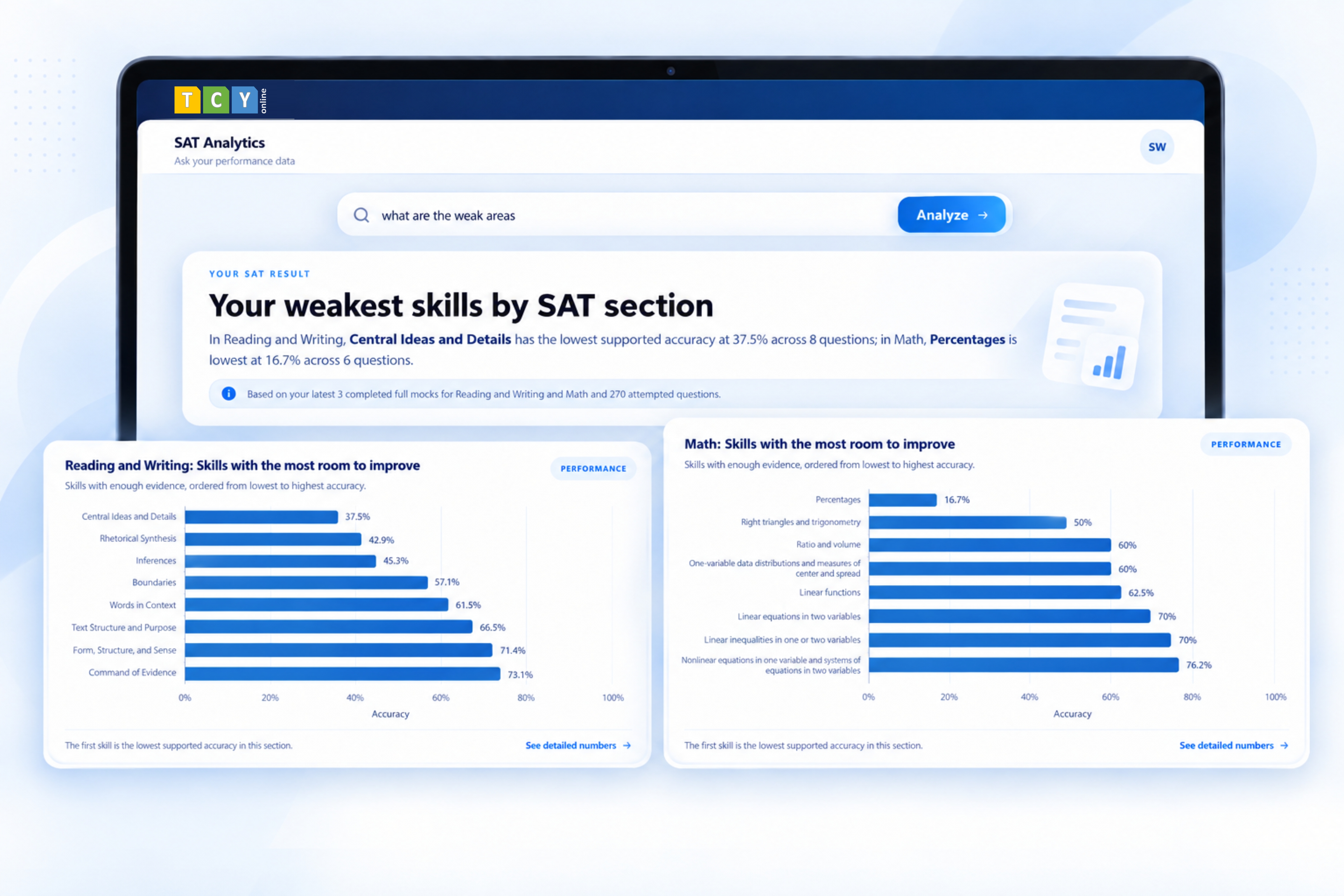
"Where am I wasting time?"
"What should I improve before my next mock?"
Behind those questions, ENA Insights decides which evidence is relevant.
Sometimes the answer needs a trend graph. Sometimes it needs a comparison. Sometimes it needs a table. Sometimes the clearest answer is simply a few sentences.
The student should have to understand their SAT performance, not learn how to operateanalytics software.
Some of the most important work happens before a graph ever appears.
An unanswered question is not treated casually as just another error. Experimental questions have to be handled correctly so they do not distort score-bearing analysis. Incomplete attempts should not quietly enter a score trend and make a student's progress look better or worse than it really is.
These may sound like small technical details.
They are not.
When these insights begin shaping a student's next move, the quality of those distinctions matters.
A polished explanation built on the wrong evidence is still the wrong explanation.
"How far am I from my target?"
A student aiming for 1500 does not really want to know that the gap is 80 points.
They want to know whether they are moving toward it and what is standing in the way.
ENA Insights approaches that question cautiously.
It looks at comparable mock performance, recent score movement and persistent high-impact weaknesses. When the evidence is strong enough, it can estimate progress across future mocks. When the evidence is limited, it says so.
That is intentional.
SAT progress is not a straight line, and a forecast should not pretend otherwise.

None of this replaces the trainer.
ENA Insights may identify that a particular Algebra skill has repeatedly caused problems, especially on harder questions.
The trainer still has to discover why.
Perhaps the student does not understand the concept. Perhaps the method is inefficient. Perhaps the problem appears only under time pressure.
That is teaching.
But the conversation can now begin somewhere more useful.
Instead of:
"I am bad at Math."
A student can arrive with:l
"This is the area that keeps showing up in my recent errors."
That is a very different conversation.
And that, in the end, is what we wanted it to do .
That it will turn a score into a conversation, a pattern into an insight, and an insight into a plan.
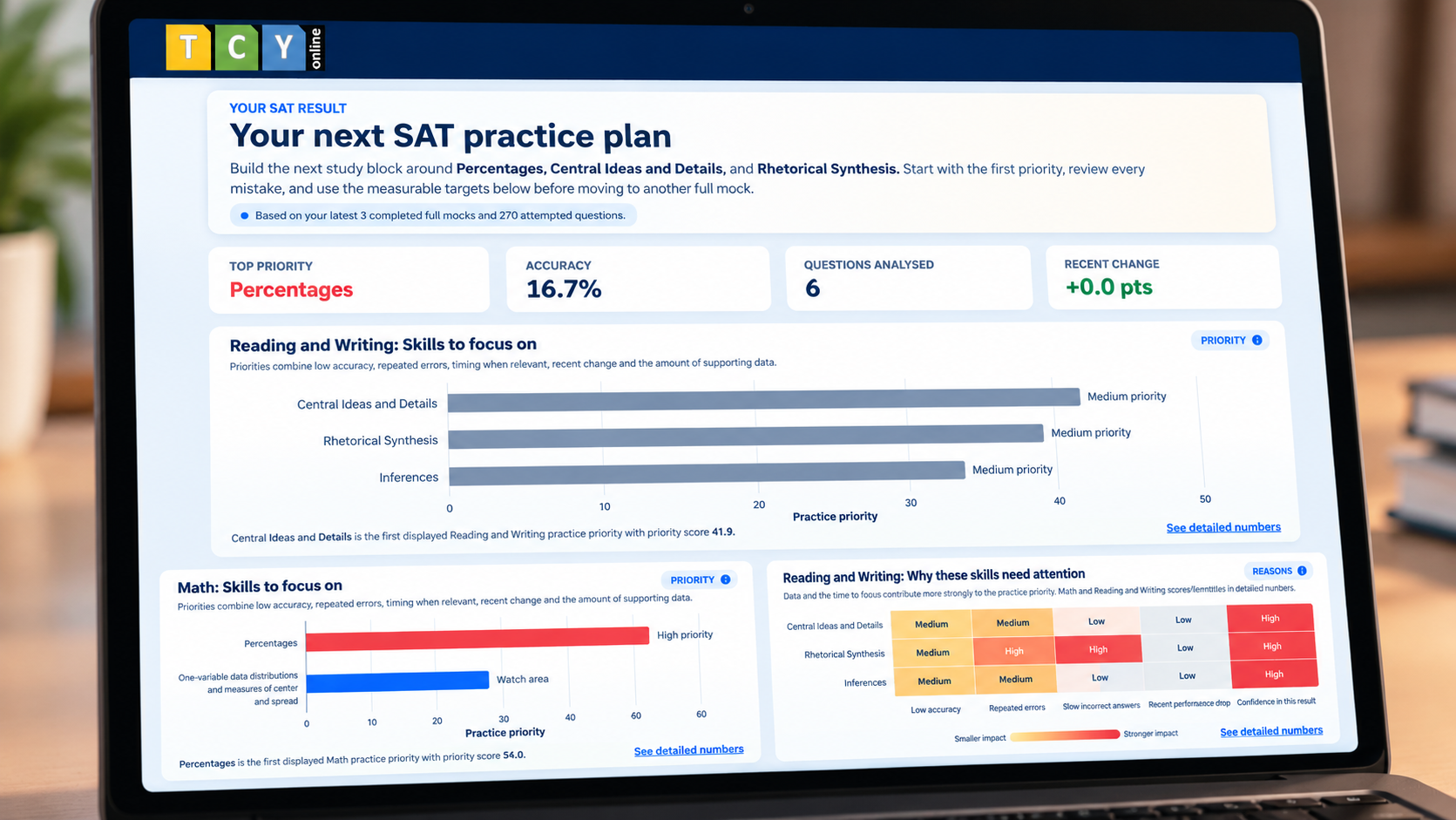
A clearer answer to the question that comes immediately after every score:
Where do I stand, and what should I do next to succeed?


